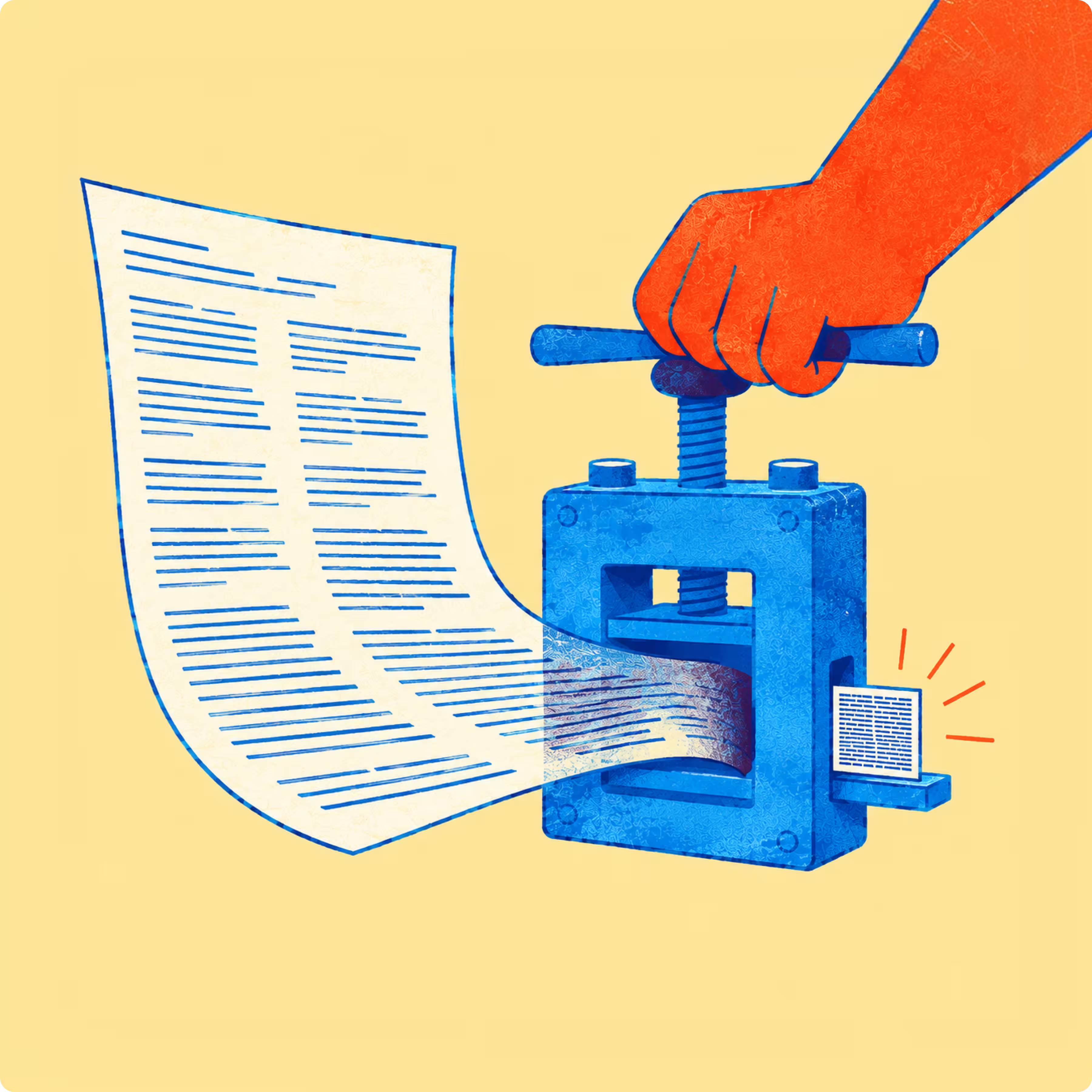



Bid leveling is the process of adjusting competing bids for the same scope so they can be compared like for like. The general contractor or owner lines up each bidder's price item by item, reads what every bid includes, excludes and assumes, prices the gaps, and only then compares totals. The goal is not to find the lowest number, but the lowest complete one, so the contract is awarded without inheriting a hidden scope gap that comes back as a change order.
This guide is for estimators, project managers and owner's representatives who compare construction bids, and for the subcontractors and suppliers on the other side who want their bid to survive that comparison. If you are comparing two quotes for a home project, a simple checklist of what each quote includes will do the same job.
Key takeaways
- Bid leveling adjusts competing bids for differences in scope, exclusions, allowances and alternates so the totals describe the same work.
- Bid tabulation lists the prices each bidder submitted, while bid leveling adjusts those prices so they can be compared like for like.
- In a leveled comparison, the lowest submitted bid can become one of the most expensive once its exclusions are priced with plug numbers.
- A standard bid form organized by trade package, such as the divisions of CSI MasterFormat, makes bid leveling faster and more reliable.
- Subcontractors whose bids state inclusions, exclusions and assumptions clearly are easier to level and less likely to be plugged with someone else's numbers.
What is bid leveling?
When five subcontractors price the same drawings, their bids rarely describe the same work. One leaves out hoisting. Another carries an allowance the estimator already budgeted. A third prices an alternate the owner did not ask for. Bid leveling is the work of removing those differences so the numbers can be compared fairly.
Most often, a general contractor levels subcontractor bids for each trade package before buying out the job. Owners and owner's representatives also level the proposals they receive from general contractors, especially on projects awarded on a lump sum or guaranteed maximum price. Public owners running a sealed bid often skip leveling and award to the lowest responsive, responsible bidder, which is why the responsiveness review on those projects is so strict.
Bid leveling vs bid tabulation
The two terms are often used as if they meant the same thing. They describe two steps of the same process.
Why does bid leveling matter?
Bid leveling matters because the cost of a contract is the price plus everything the price leaves out. Scope that falls between two trade packages does not disappear. It returns during construction as a change order, a dispute or a delay, usually when there is no competitive pressure left to price it.
Leveling also protects the schedule and the relationship. A subcontractor who won on a number that excluded half the scope is under pressure from day one. Finding that gap before award lets the general contractor either price it into the comparison or ask the bidder to include it, while there is still a choice.
How do you level construction bids, step by step?
The process below is how most estimators level trade bids. The same steps work for an owner comparing general contractor proposals, with larger line items.
1. Define the scope package before bids go out
Leveling starts before the first bid arrives. Write a scope of work for each package, organized by trade, and decide where the boundaries sit between packages: who patches after the mechanical trades, who provides hoisting, who carries temporary protection. Many contractors organize packages by the divisions of CSI MasterFormat, so every bidder reads the same structure.
2. Issue a standard bid form
A bid form lists the line items, unit prices and alternates you want priced, in the order you will compare them. It turns ten differently structured proposals into ten rows in the same spreadsheet. Bidders still attach their own qualifications, but the core numbers arrive comparable.
3. Tabulate the bids as submitted
Enter every bid into the leveling sheet exactly as received, one bidder per column and one line item per row. Do not adjust anything yet. This is your record of what each bidder actually offered.
4. Read every inclusion, exclusion and qualification
This is the step that separates leveling from tabulation. Read each bidder's scope letter and qualifications line by line, and mark every item that differs from the scope package: excluded work, added assumptions, conditions on schedule or access, and allowances. Exclusions are often in the last paragraph of a cover letter, which is exactly why they get missed.
5. Normalize the numbers
For each gap, add a plug number to the bids that excluded the scope, based on what the other bidders or your own estimate carry for it. Align alternates so every bidder is compared on the same options. Replace bidder allowances with the amount you intend to carry, so the comparison reflects real cost rather than optimistic placeholders.
6. Check quantities and unit prices for outliers
A unit price far below the others can mean a misread drawing rather than a better price. When one bidder is far lower on a single line, check their quantity before celebrating. A bid built on a mistake is a risk to the project, not a saving.
7. Hold a scope review with the leading bidders
Before award, walk the scope with the top two or three bidders. Confirm what they included, ask them to price any excluded items you would rather they carried, and record the answers in writing. This call often closes most of the gap between the leveled totals.
8. Document the decision
Keep the leveling sheet, the plugs and their source, the notes from the scope review and the reason for the award. If the owner asks why you did not take the lowest number, the leveled comparison is the answer.
What does a leveled bid look like? A worked example
The example below uses illustrative figures for a drywall and framing package on a mid-rise building. Three bidders priced the same drawings. Bidder A submitted the lowest number, but excluded three items the other bidders carried.
After leveling, Bidder B is the lowest complete price by $10,800, and Bidder A, the apparent winner on the bid sheet, is the most expensive. The general contractor can now hold a scope review with B and C, or ask A to include the excluded work and resubmit. Without leveling, the $61,500 of excluded scope in Bidder A's number would have surfaced during construction.
How owners level general contractor proposals
Owners level too, one level up. When general contractors submit lump sum or guaranteed maximum price proposals, the owner or owner's representative compares general conditions, fee percentages, contingencies, allowances and the list of clarifications each contractor attached. Two GMPs a few percent apart can hide very different allowances for unfinished design, and the lower one may simply carry less of the risk the owner will end up paying for.
The method is the same as for trade bids: put every proposal in one structure, read the qualifications line by line, normalize allowances and contingencies to the same assumptions, and only then compare totals. Many owners also compare fee and general conditions separately from the cost of the work, because those are the numbers that stay fixed while the scope is still being designed.
What are the most common bid leveling mistakes?
How do you write a bid that levels well?
If you are the subcontractor or supplier, bid leveling is happening to your proposal whether you think about it or not. The estimator will read your exclusions, plug any gaps with numbers from your competitors, and compare the result. A bid written to be leveled gives you control over that comparison.
Price on the bid form, in the order it asks, and do not merge lines the estimator will need to separate. List inclusions and exclusions in one clear section near the price, not in the closing paragraph of a cover letter. State your assumptions about access, schedule, hoisting and protection explicitly. If you exclude something for a good reason, say why and offer a price for it as an alternate, so the estimator does not have to guess with someone else's number.
The same discipline applies to the written proposal around the price. Our guides to the RFP process and to evaluation criteria cover how buyers score the non-price parts of a construction bid.
What tools help with bid leveling?
Most teams still level in spreadsheets, often from a template that mirrors their bid form. Construction preconstruction platforms add bid management features: inviting bidders, collecting bids in a standard structure and comparing them side by side. Newer tools use AI to read subcontractor proposals, extract line items and flag missing scope, which speeds up the reading step but still needs an estimator to judge each plug and each exclusion.
Cobl sits on the other side of the table. It is not a bid leveling tool for general contractors. Cobl is the AI deal assistant for teams selling complex solutions, and for contractors and suppliers it helps produce the bid that gets leveled. It reads the bid package and RFP documents, pulls out the scope, the required forms and the deadlines, and produces the technical proposal, the qualifications and exclusions, and the pricing grid from your company knowledge. Pricing grids, bid grids and unit-price schedules are edited in Excel inside Cobl, so the numbers go back in the format the estimator asked for.
Construction companies including Altrad use Cobl, as shown on our construction industry page. Every price and every exclusion is still reviewed and approved by your team before it leaves. To try it on a real package, test Cobl on a live RFP.
Compare the work, not the number
Bid leveling is how construction teams make sure they compare the same work before they compare prices. Owners and general contractors who level carefully award with fewer surprises. Bidders who write clear, complete, form-compliant bids are the ones who come out of leveling looking as good as their number.



.avif)