


AI proposal software: The game-changer for sales teams
Discover how AI proposal software helps sales teams create faster, personalized, and data-driven proposals that boost efficiency and close more deals.

Your sales team doesn't have to spend an entire day churning through proposals anymore. AI proposal software can take on the bulk of the manual work involved in putting proposals together without sacrificing the human touch. That leads to better proposals and more closed deals, all while requiring less work from your salespeople.
But identifying the right tool is just as important as using one at all.
In this guide, you’ll see how AI is a complete game-changer for creating proposals, and why the right tool will transform the way your sales team works.
What Makes Proposal Software “AI-Powered?”
Most tools your sales team uses have some level of automation that can pass for AI. Your CRM might automatically send marketing emails while your prospecting tools pull contact information from LinkedIn and other platforms, but these automations don’t make these tools “AI-powered.”
AI-powered proposal software leverages AI at every stage of the process, while giving your salespeople the ability to customize what it creates and approve the final output.
The Technology Behind AI Proposals
AI-powered proposal software uses specific AI technologies that save your teams time and effort without sacrificing the detail and thoroughness your proposal process needs. Here is some of the technology involved:
- Natural language processing (NLP): At the core of everything AI-powered proposal software does, NLP allows these platforms to understand, interpret, and generate human language.
- Machine learning: Through machine learning, an AI tool can take a massive amount of data and identify patterns that allow it to improve at specific tasks.
- AI agents: AI agents are about as close as you can get to having extra teammates. They can independently take actions and make decisions, like fetching customer data, sending proposals out for approval, and making changes based on your feedback.
Why Traditional Proposal Tools Can’t Keep Up
Traditional proposal tools usually give you pre-built templates to streamline proposal writing. While this is a good place to start for many sales teams, these tools can rarely keep up with you as you grow.
The Template Trap: Why Copy-Paste Isn’t Enough
Templates are a great asset for your sales team. But while they can save you some time and effort, their capabilities are limited, usually by the amount of effort you can put into creating, documenting, and managing them. Relying on templates for proposals eventually just isn’t enough. As your sales volume increases, you have to put more and more of them together. Not to mention all the work that goes into customizing them for each client.
The Scale Problem: Growing Teams, Growing Pains
Templates aren’t enough, especially as your team scales. When your team reaches a certain size, relying on templates starts creating more problems than it solves:
- Documentation: The more people rely on a template, the harder it is to document any updates or changes made to it. Likewise, as you increase the number of products or services you offer, you’ll need more templates than you can appropriately document.
- Reliability: As your team grows, every member starts making their own copies of your templates and their own changes. With each copy having its own minor differences, no one knows which copy to use, and they lose trust in your templates.
- Relevance: The templates your team creates when they’re still small usually don’t stay relevant for long. Pricing plans and terms change, but what makes a proposal successful also evolves as you grow. Unless you’re willing to constantly update templates (or create new ones), they’ll become less and less relevant over time.
How AI Proposal Software Changes the Game
When you start using AI-powered proposal software, you’ll see the difference in the way you work.
From Hours to Minutes: Speed Revolution
Sales teams that spend hours generating each proposal are spending less time closing deals. AI proposal software eliminates much of the manual work involved, allowing each proposal to be generated in minutes rather than painstakingly written over hours. What can your sales team accomplish with all that reclaimed time?
From Generic to Personalized: Quality at Scale
When sales teams manually write every proposal, they’re bound to rely on templates. The problem? They often have to sacrifice personalization and customization, sacrifices that increase as they scale. Instead of settling for “good enough,” AI proposal software allows you to completely customize every proposal to every potential client
From Guesswork to Data-Driven: Intelligence That Improves
Your sales team has a massive amount of institutional knowledge, but they don’t always get the right avenue to deploy it. The AI technology built into proposal software like Cobl allows it to learn from your proposals over time, decreasing the burden on your documentation and your team. Successful proposals can be stored and reused for other deals, building up a knowledge base that improves over time.
3 AI Capabilities That Transform Proposal Creation
Capability #1: Smart Content Generation
AI-powered proposal software uses machine learning and natural language processing to automatically generate robust, customized proposals based on your prompts. Chatbot interfaces and similar features also allow you to request changes and updates with natural language, the same way you would with a coworker.
Capability #2: Dynamic Personalization at Scale
Software like Cobl can customize proposals so they’re always on-brand and always specific to your prospects. Unlike manually making these changes yourself, AI can make updates at scale, meaning you don’t have to sacrifice personalization when you grow.
Specifically, Cobl’s style extractor can pull style elements from your brand to keep proposals on-brand and from prospect information so proposals are always deeply personalized.
Capability #3: Memory and Continuous Learning
One of the greatest advantages of using AI-powered proposal software is its ability to learn from the way you write proposals over time. As you request edits, your proposal software remembers every little change, refining the way it writes. It understands your clients and learns from your deal cycle, meaning you never have to start your proposals from scratch.
AI Proposal Software vs. Traditional Proposal Tools
Traditional proposal tools might be popular, but they’re far more limited than their AI-powered counterparts.
Feature Comparison: What You Get with AI
| Feature | AI-powered proposal software | Traditional proposal tools |
|---|---|---|
| Proposal creation | ✓ | ✓ |
| Proposal editing | ✓ | ✓ |
| Content library | ✓ | ✓ |
| Templates | ✓ | ✓ |
| CRM Integration | ✓ | ✕ |
| Style extractor | ✓ | ✕ |
| Automated proposal generation | ✓ | ✕ |
| Learns from every proposal | ✓ | ✕ |
| Natural language editing | ✓ | ✕ |
| Automated research & approvals | ✓ | ✕ |
| Independent AI agents | ✓ | ✕ |
ROI Comparison: The Business Case for AI
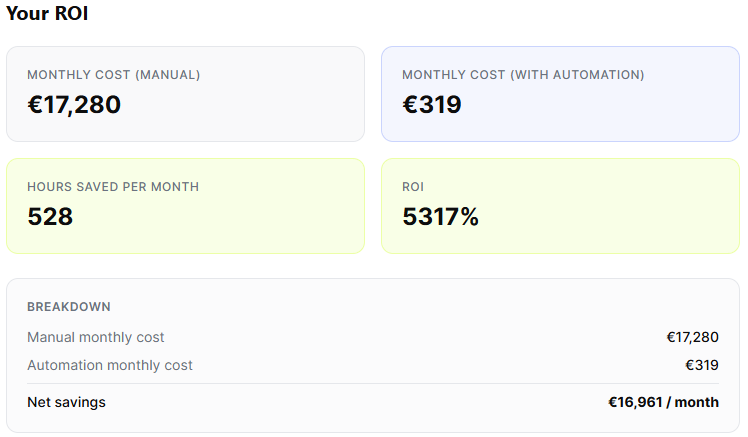
AI-powered proposal software leads to immediate productivity gains. We’ll be using Cobl’s Sales Proposal ROI Calculator to demonstrate this. Imagine your sales team of six reps sends out eight proposals a week, with each proposal taking three hours to prepare. Each rep is paid €30 an hour.
With that math, you’re looking at a rough monthly cost of €17,280 to generate these proposals.
Now imagine you used AI-powered proposal software that costs €79 a month, and cut the time to generate each proposal down to 15 minutes. Here’s how much time and money you’d save.
With a platform like Cobl, you can start for free and generate your first proposal in minutes. Get early access to the platform here and see how.
Real Impact: What AI Proposal Software Achieves
Here are just a few examples of organizations that have seen the impact of using Cobl to automatically generate their proposals.
50% reduction in request for proposal response times
Open supports private and public organizations in IT & digital transformations. Working with the public sector requires the production of strict, formal proposals that meet specific requirements and SLAs. This led to a massive workload of repetitive tasks, where precision was essential. Using Cobl, Open’s team could get a proposal in minutes, with each proposal meeting the specific requirements necessary to work with public sector partners.
Find Open’s full story here.
350% ROI
Free Pro had a problem. They managed to get proposals out the door quickly, but they found themselves sacrificing specificity and personalization, meaning they didn’t always win deals they should have won. Putting more time into each proposal didn’t make sense, causing them to fall behind on their goals. When they started using Cobl, they were finally able to generate proposals on time with unique, controlled content that won them more deals.
See the full story here.
66% faster document creation
CERAP Prévention is a leader in nuclear engineering and radioprotection, fields where expertise and precision are essential. That meant RFPs didn’t lead to quick documents that any salesperson could produce. The documents they created could easily reach 200 pages. Up to 60% of the content was the same across each document, but the rest needed to be personalized, reviewed, and validated. That’s why CERAP Prévention turned to Cobl, allowing them to quickly produce rigorous, essential documents.
Find the full story here.
Addressing Common Concerns About AI in Sales
AI-powered proposal software has a net ROI that’s immediately provable. That said, there are legitimate concerns around what it can actually achieve.
"Will AI Proposals Sound Robotic?"
Absolutely not. AI platforms might have struggled to generate unique, humanlike text several years ago, but modern AI platforms can sound just like your sales reps.
"Can AI Handle Complex, Technical Proposals?"
No matter how complex or technical your proposals are, AI agents can find the information they need to create precise documents that meet all your needs. Each AI agent can break down complex documents into small manageable tasks, handling them autonomously.
"What About Data Security and Confidentiality?"
AI-powered proposal platforms like Cobl maintain strict security compliance, encrypt your data, and monitor your information 24/7 to prevent malicious access. With Cobl, your data is especially safe as it isn’t used for any hidden training, and it’s hosted by Scaleway, a sovereign cloud provider in France.
"Is AI Proposal Software Too Expensive?"
Not only does AI proposal software come with almost immediate ROI, but it’s usually no more expensive than the other software tools you’re already using.
Choosing the Right AI Proposal Software
Here’s your guide to choosing the right AI proposal software.
Must-Have Features Checklist
- A chat-based interface to create proposals based on natural language prompts.
- Deep editing and customization so proposals are always on-brand.
- Exports for common file formats like PDF, Word, and PowerPoint.
- Agentic AI for autonomous task handling.
- Data ingestion and internal document consultation.
- Built-in business logic.
Integration Requirements
Ensure that the proposal software you use can integrate natively with the tools your sales teams use, including:
- CRMs (e.g., HubSpot, Salesforce)
- Contact management platforms (e.g., Google Contacts)
- Spreadsheet tools (e.g., Excel)
- Prospecting software (e.g., Zoominfo)
- Workspaces (e.g., Notion)
- Email (e.g., Gmail, Outlook)
Pricing Models Explained
When evaluating AI proposal software, you’ll find two main types of pricing models: credit-based and subscription-based. A subscription model is typically best for teams as they scale, since you’ll pay a flat rate every month. Credit-based models can be more preferable for small, pilot projects.
Implementation and Training Considerations
AI-powered proposal software doesn’t typically require any advanced training; you’ll still need to budget some time to get your team up to speed. One of the best ways to do that is by choosing a champion on your sales team who can test the tool, establish best practices, and spread usage throughout the team.
Getting Started with AI Proposal Software
Change Management: Getting Team Buy-In
Change management allows you to get buy-in from stakeholders involved in the proposal generation process and manage risks as you transition from your existing process to a new tool. Consider the following best practices:
- Identify stakeholders early and get their perspective.
- Loop in stakeholders when you choose a platform and start implementing it.
- Identify risks and create a plan for managing them.
- Start your implementation with a pilot project and review its results before wider implementation.
Measuring Success: KPIs to Track
To gauge the impact of your AI-powered proposal software, you can track the following metrics:
- Average time for proposal creation.
- Average time spent reviewing generated proposals per rep.
- Proposal accuracy percentage.
- ROI (using this calculator).
Proposals that work for you (instead of making you work)
AI-powered proposal software saves precious time and effort drafting proposals. Machine learning allows these tools to improve on your proposals over time, while chat interfaces mean you can request edits the same way you would with a coworker, and AI agents automatically take on tasks involved with process generation.
Want to see this in action? Get early access and try Cobl for free!